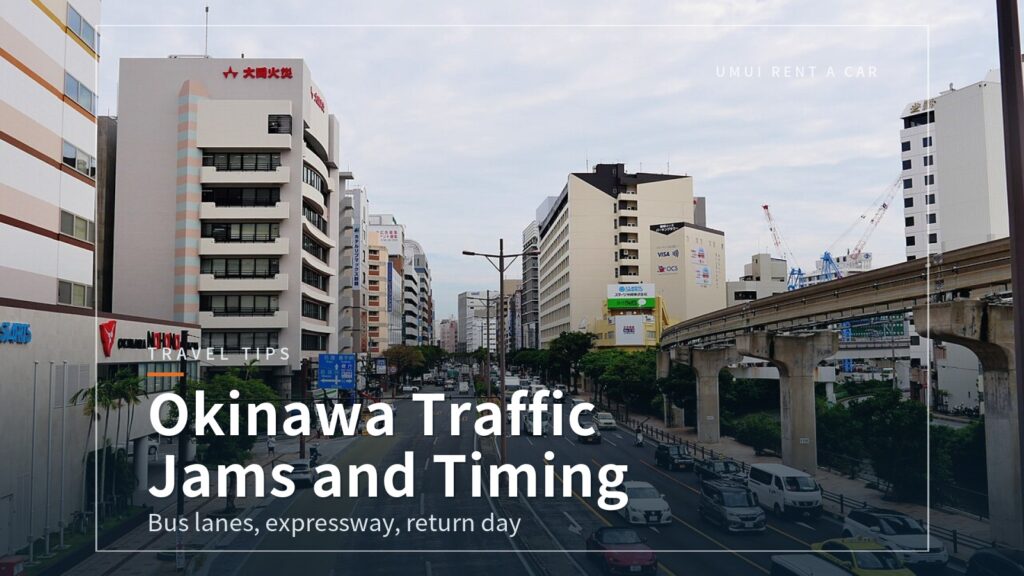
“I heard you can go anywhere in Okinawa by car, but how bad is the traffic?” It is one of the questions first-time visitors ask us most often. The sights are spread out across the island, so a rental car is a big help. But there is no railway, and the main roads get crowded on weekday mornings and evenings and during holiday periods. If you pack too much into a day, you can end up struggling to return the car or catch your flight on time.
This article focuses on the overall traffic pattern on Okinawa’s main island and how to plan around it. It covers the times and sections that tend to be congested, the basics of bus lanes, how to choose between expressways and local roads, how to estimate travel times, how to check traffic information, and how to leave a safe margin on your return day and before your flight. Everything here is based on information we could confirm from official sources such as Okinawa Prefecture, the Okinawa General Bureau, and the Okinawa Prefectural Police. For parking and traffic inside Naha city, and for expressway ICs and tolls, we have separate articles, so please see the links below as well.
Why Okinawa’s Main Island Gets Congested
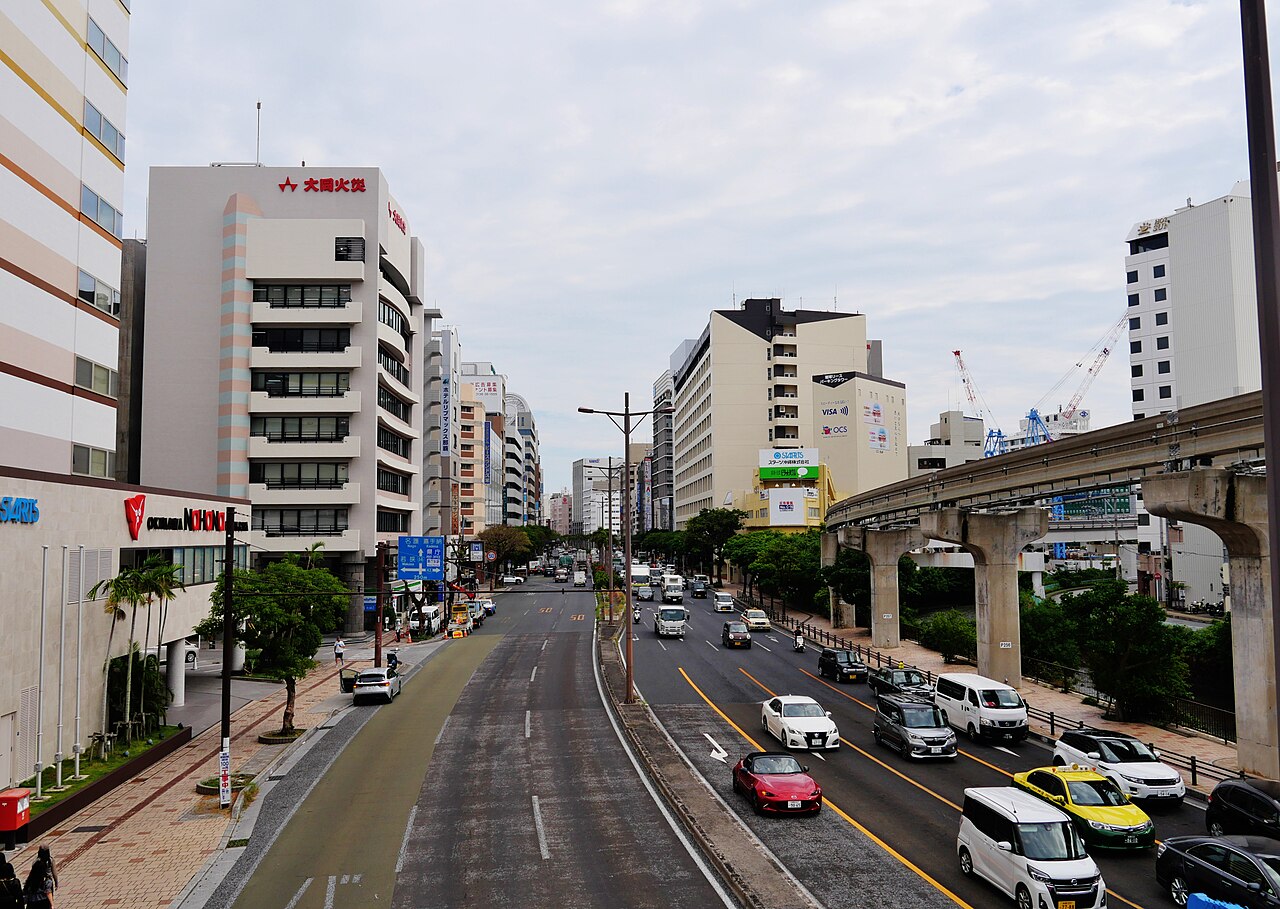
An island with no railway, where people rely on cars
According to an Okinawa Prefecture document (Transport Policy Division, Planning Department, January 30, 2026), the only scheduled, constant-speed public transport in the prefecture is the Okinawa Urban Monorail (Yui Rail), which runs through parts of Naha and Urasoe over a distance of 16.9 km. The prewar Okinawa Light Railway was destroyed in the war and never restored. As a result, many people depend on cars for both commuting and sightseeing, and traffic tends to concentrate on the roads.
The same document states that the travel speed in Naha during weekday congestion is lower than in the three major metropolitan areas. Don’t assume that “Okinawa is laid-back, so there won’t be traffic.” Travel speeds in Naha on weekdays during congestion are lower than in the three major metropolitan areas, and keeping that in mind will make planning easier.
The national and prefectural governments are working on congestion
In Okinawa, the Okinawa Regional Congestion Countermeasures Promotion Council, which brings together the national government, the prefecture, municipalities, the police, NEXCO and others, identifies congestion-prone locations and carries out countermeasures. The Okinawa Prefecture website lists examples around Naha, such as intersections near Asahibashi and Omoromachi Station where right-turn lanes were added or right-turn queuing space was extended. Road improvements are gradually moving forward, but some places are still crowded.
What we travelers can do is learn in advance when and where traffic builds up, then either avoid it or pass through with time to spare. The following sections provide the information to do that.
Local buses are affected by traffic jams too
The prefectural document mentioned above includes a table comparing the travel time of local buses heading for Naha Bus Terminal during the morning peak (services arriving around 8:30) and off-peak hours (services departing around 10:00 to 12:00). It concludes that local buses are affected by traffic congestion, and that the effect of the morning peak is up to about 30 minutes. Cars can maneuver more flexibly than buses, but it is safest to assume that roads heading toward Naha in the morning peak will take extra time as well.
Times When Traffic Tends to Be Heavy
On weekday mornings and evenings, avoid moving around Naha
On weekday mornings and late afternoons, which are commuting hours, traffic on the main roads in and around Naha tends to increase. The bus lane regulation hours (7:30 to 9:00 in the morning, 17:30 to 19:00 in the evening) also fall in these periods. We can’t say that the regulated hours and the congested hours match exactly, but it is wise to avoid plans that take you across Naha during these hours whenever you can.
For example, after picking up your car near Naha Airport, you can have breakfast nearby to let the commuter peak pass instead of heading north right away, or you can wrap up sightseeing early in the evening and return to your hotel before the roads fill up. We also touch on sightseeing and parking in Naha in our “Naha Sightseeing and Parking Guide”.
On weekends and holidays, roads to the sights get crowded
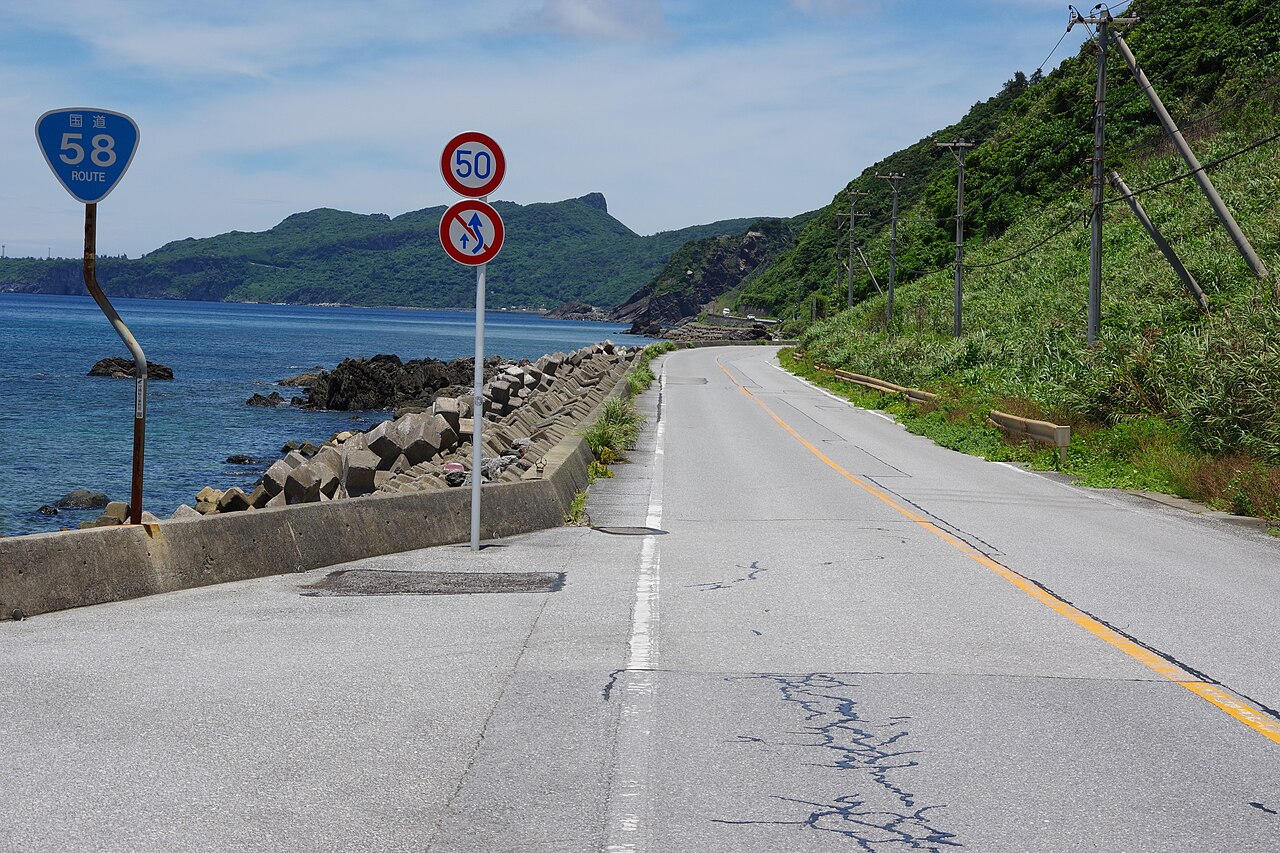
During long holiday periods such as Golden Week and Obon, tourists and locals are all on the move, so the roads to northern Okinawa tend to get crowded. According to a news report (Ryukyu Shimpo) on the content of “Ashinavi,” the road information magazine published by the Northern National Highway Office of the Okinawa General Bureau, traffic jams during the holidays usually concentrate on northbound trips in the morning and southbound trips in the evening. The Northern National Highway Office says that, to avoid traffic jams, it is important to spread out both travel times and routes.
The places reported as likely to be crowded include the area around Kyoda IC on the Okinawa Expressway, the area around Ijagawa IC on the Nago East Road, and the Sefuji intersection in Nago City on National Route 58. As for departure times, the reported advice is that traffic tends to build from the 9 a.m. hours until around noon, so it is better to leave early or to start moving after midday. Actual congestion times and travel times differ from year to year, so please check the latest announcements from the Northern National Highway Office.
| Directions that get crowded | During holidays, northbound in the morning (from the Naha area toward the north) and southbound in the evening (from the north toward Naha) |
|---|---|
| Places reported as crowded | Around Kyoda IC, around Ijagawa IC, and the Sefuji intersection in Nago City on National Route 58 |
| Source of information | News reports on the content from the Northern National Highway Office of the Okinawa General Bureau (“Ashinavi” road information magazine). Figures differ from year to year, so we have not listed travel times |
On rainy days, allow more time than usual
We could not find official statistics or figures on traffic jams on rainy days in Okinawa. We therefore can’t say how much traffic increases, but on any road, rain reduces visibility and worsens road conditions, and more cars drive slower than usual. On rainy days, we recommend setting off with more margin than your planned travel time.
When a typhoon is approaching, roads may be closed and shops may change their business hours. Please also see our article “Renting a Car During Typhoon Season.”
Section by Section: What to Watch For and Where
National Routes 58, 330 and 329, and around Naha
National Route 58 is the main road that runs north along the west coast of the main island, through Naha, Urasoe, Ginowan and Chatan. The Okinawa Prefectural Police bus lane map also centers on Route 58, and the names of National Routes 330 and 329 appear on it as well. However, we could not find officially published figures for travelers showing how congestion differs by section, so we do not claim anything in a ranking-style list.
| National Route 58 | The main road linking the west coast from south to north. Bus lane regulations apply in places such as inside Naha. Congestion near the Sefuji intersection in Nago City is advised for holiday periods |
|---|---|
| National Route 330 | Its name appears on the police bus lane map. We could not confirm official figures on its level of congestion |
| National Route 329 | Its name appears on the police bus lane map. In the north, the Northern National Highway Office recommends it as a detour along the east coast (see the section below) |
| Around Naha Airport and inside Naha | On weekday mornings and evenings, traffic tends to gather on the main roads of the urban area. Check the bus lane hours on the road signs |
| Around Chatan | Along National Route 58. We could not confirm official congestion figures. Follow the pattern of Route 58 on weekday mornings, evenings and holidays, and allow extra time |
The stretch just after leaving Naha Airport
If you pick up your rental car at Naha Airport, the first drive begins right after you take the keys. On weekday mornings, evenings and during holidays, it may take time to merge onto the main roads in the urban area. To avoid getting flustered on unfamiliar roads, set your navigation system before you leave and adjust your mirrors and seat before you start driving. UMUI Rent a Car’s Naha Airport store offers a free shuttle from the airport and is open every day of the year from 8:00 to 20:00.
Along National Route 58 in Chatan, Ginowan and nearby
Popular spots such as American Village in Chatan line National Route 58. Cars turning into the parking lots of tourist spots can sometimes slow the flow of Route 58, so it helps to decide in advance where you will park and how you will enter.
Bus Lane Regulation Basics
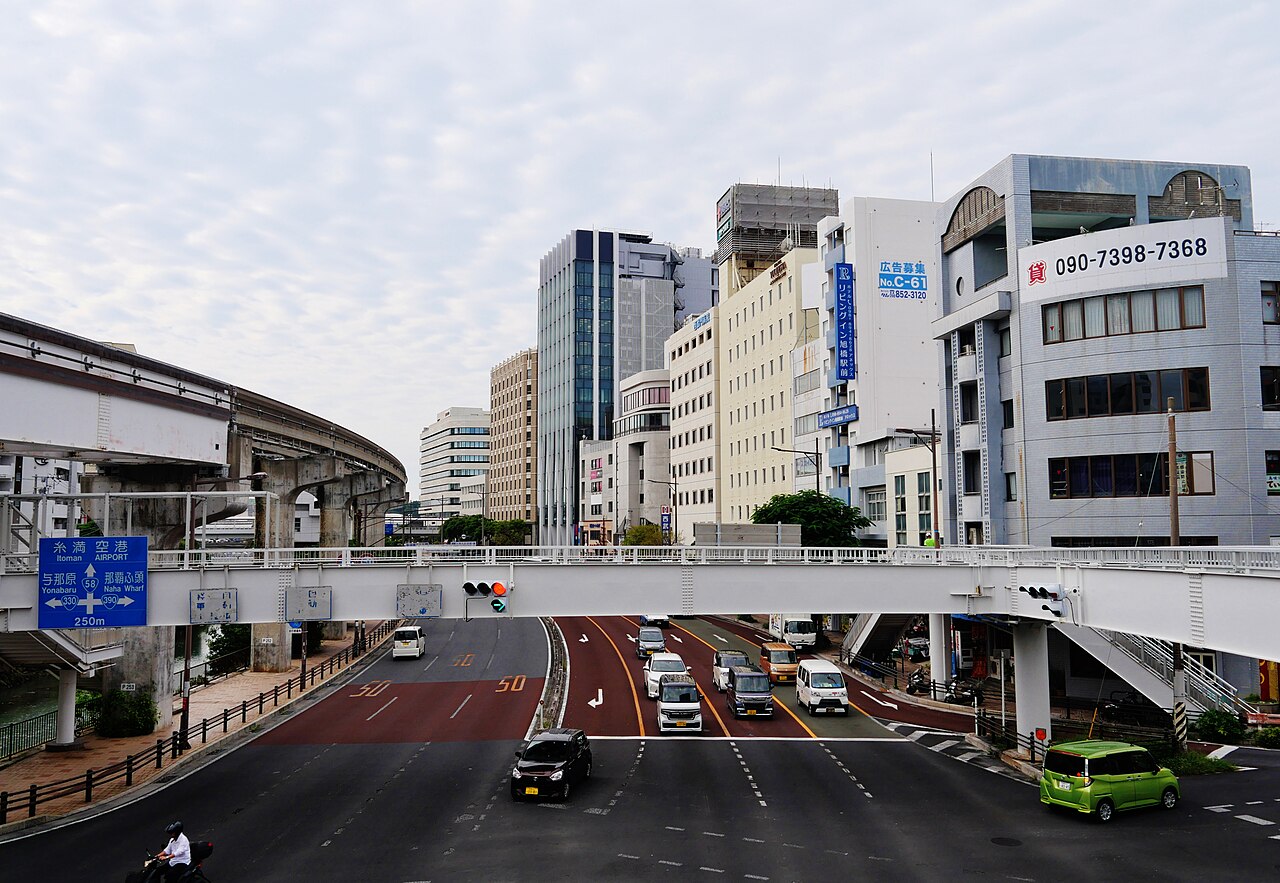
Hours, and days without regulation
According to the Okinawa Prefectural Police bus lane map (valid from May 2, 2025), the regulated hours and targets are as follows. For more detailed explanations of bus lanes in Naha, see our articles “Naha Sightseeing and Parking Guide” and “Driving Rules in Japan for Visitors.”
| Regulated hours | Morning 7:30 to 9:00 / Evening 17:30 to 19:00 |
|---|---|
| Days without regulation | Saturdays, Sundays and holidays, January 2 and 3, and when local buses are not running (typhoons, etc.) |
| Ordinary vehicles (rental cars, etc.) | Not allowed in the bus lane. Drive in the lanes other than the bus lane |
| Inquiries | Okinawa Prefectural Police Headquarters, Traffic Regulation Division: 098-862-0110 (ext. 5172) |
During the regulated hours, ordinary vehicles may not drive in the bus lane. Check the location of the lane using the road signs and road markings. Regulations may change, so please check the Okinawa Prefectural Police page for the latest information.
The two types of regulation, and what happens if you violate it
The police page explains bus lane regulation in two types: the “bus-only lane” (バス専用通行帯), applied to the first lane on the sidewalk side of multi-lane roads such as National Route 58, and the “bus-only road” (バス専用道路), applied to one-lane-each-way roads such as Kokusai-dori. Because the sign designs and the contents of the regulations differ, drivers are advised to check them carefully.
As for the treatment of violations, we found no description of penalties on the police bus lane page. For reference, the Tokyo Metropolitan Police’s list of traffic fines shows the fine for a “lane-use violation” (通行帯違反) for ordinary cars as 6,000 yen. However, we have not been able to confirm which violation category applies to bus lane violations, so if you are concerned, please ask the Traffic Regulation Division of the Okinawa Prefectural Police. In any case, the most important thing to avoid entering by mistake is to watch the signs and road markings when driving in the city on weekday mornings and evenings.
Choosing Between Expressways and Local Roads
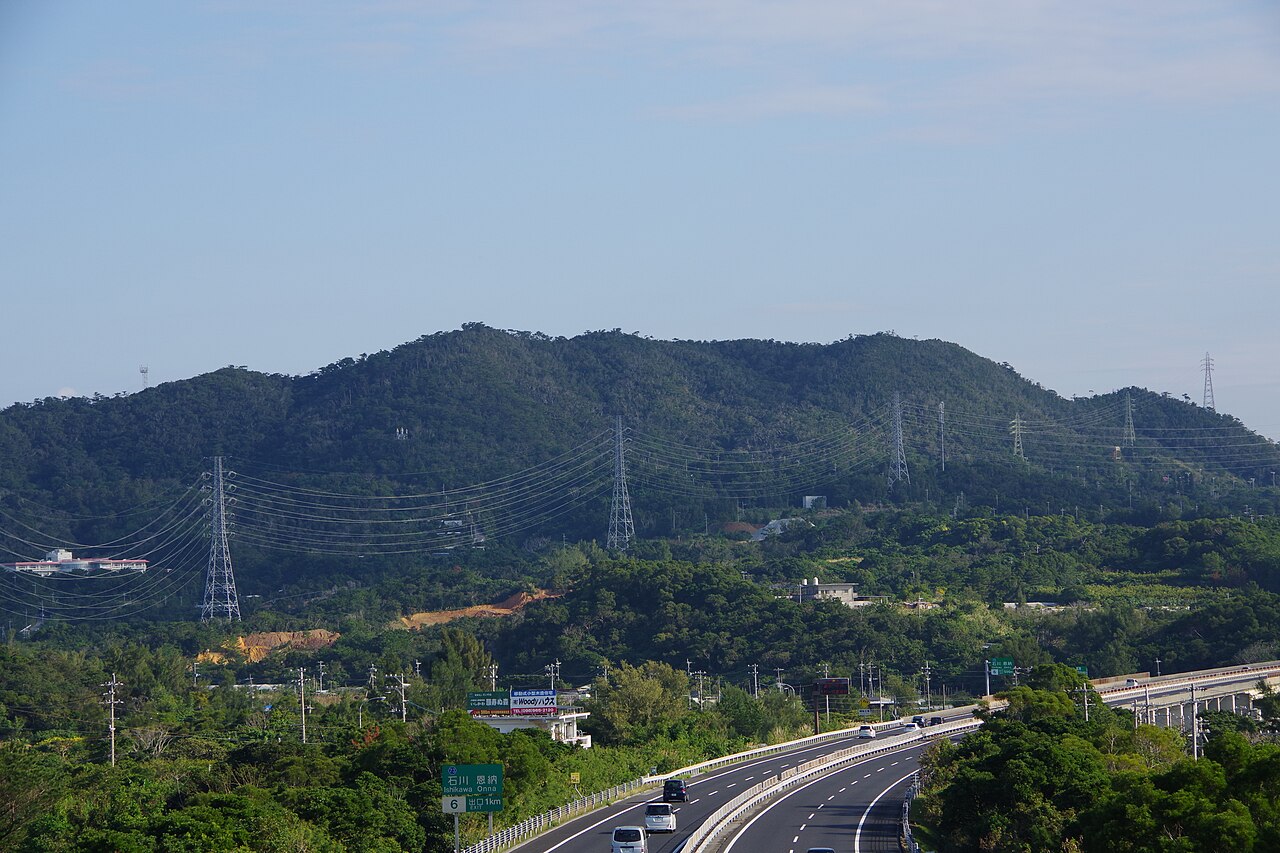
On days you head north, make the expressway your ally
The only expressways on the main island are the Okinawa Expressway, which runs the length of the island from south to north, and the Naha Airport Expressway, which connects to it. On days you head north, taking the expressway, which has no traffic lights, helps you avoid waiting at signals and crowded intersections on local roads. For ICs, tolls, the ETC discount and rest stops, see our “How to Use the Okinawa Expressway” article.
However, using the expressway does not always mean avoiding traffic. The Northern National Highway Office notes that the area around Kyoda IC, the northern terminus, tends to get crowded during holidays. Before you leave, check official information on expressway congestion and lane closures due to roadwork.
An officially recommended detour: Ginoza IC to National Route 329
As an example of a route to avoid congestion, the Northern National Highway Office is reported to recommend that you leave the expressway at Ginoza IC, one exit before Kyoda IC, and head north on National Route 329 along the east coast. The explanation is that, compared with National Route 58 on the west coast, traffic is lighter and you are more likely to move smoothly. Kyoda IC and the area around Ijagawa IC on the Nago East Road are expected to be crowded during holidays, and drivers are advised to avoid them.
For travel toward the villages of Kunigami, Ogimi and Higashi, and toward Kouri Island, the Northern National Highway Office is also reported to recommend a route from Ginoza IC along National Route 329 and then a city road near Haneji Dam. Please check the detailed route in the office’s announcements or on your navigation system.
Don’t take “shortcuts” guided by navigation alone
When there is a traffic jam, navigation may guide you onto narrow residential streets. Residential areas, the surroundings of schools and roads with poor visibility have many pedestrians and cyclists, and they are dangerous on unfamiliar ground. This article introduces only detours advised by public bodies such as the Northern National Highway Office, and routes that use expressways. We do not recommend looking for “shortcuts” on narrow roads that have not been officially advised.
Estimating Travel Time and Checking Traffic Information
Add a margin to the “no traffic” time
The travel times shown by navigation systems and in articles are often estimates for when there is no traffic. For example, our expressway article gives about 1 hour to 1 hour 15 minutes from Naha Airport to Kyoda IC when there is no congestion. In reality, it can take longer on weekday mornings and evenings around Naha, and on the northbound routes during holidays.
The trick to estimating is to add a margin on top of the navigation’s travel time. The prefectural document shows an example where bus travel times grow by up to about 30 minutes in the morning peak. You can’t apply this figure directly to cars, but giving yourself roughly 30 minutes of margin for plans that pass through the Naha direction on weekday mornings and evenings will put your mind at ease. On days with heavy traffic, also plan one fewer stop.
Official sources for traffic information
Before you leave and while driving, the following public information sources are useful.
| Japan Road Traffic Information Center (JARTIC) | Its “Road Traffic Information Now!!” provides information on expressways, urban expressways and ordinary roads 24 hours a day, updated every 5 minutes. Official site: https://www.jartic.or.jp/ |
|---|---|
| NEXCO West Japan | Check congestion and roadwork lane restrictions on the Okinawa Expressway and Naha Airport Expressway through NEXCO West Japan’s road traffic information |
| Okinawa General Bureau, Northern National Highway Office | Publishes congestion countermeasures for national roads in the north and holiday congestion outlooks through the “Ashinavi” road information magazine and other channels |
| Okinawa Prefectural Police Headquarters, Traffic Regulation Division | Contact for inquiries about traffic regulations such as bus lanes: 098-862-0110 (ext. 5172) |
Congestion displays in navigation apps are handy too, but use them as a supplement and check them together with the official information above. Before you set out, make it a habit to check the day’s congestion and regulations through official road traffic information such as JARTIC.
Leaving a margin on your return day and before your flight
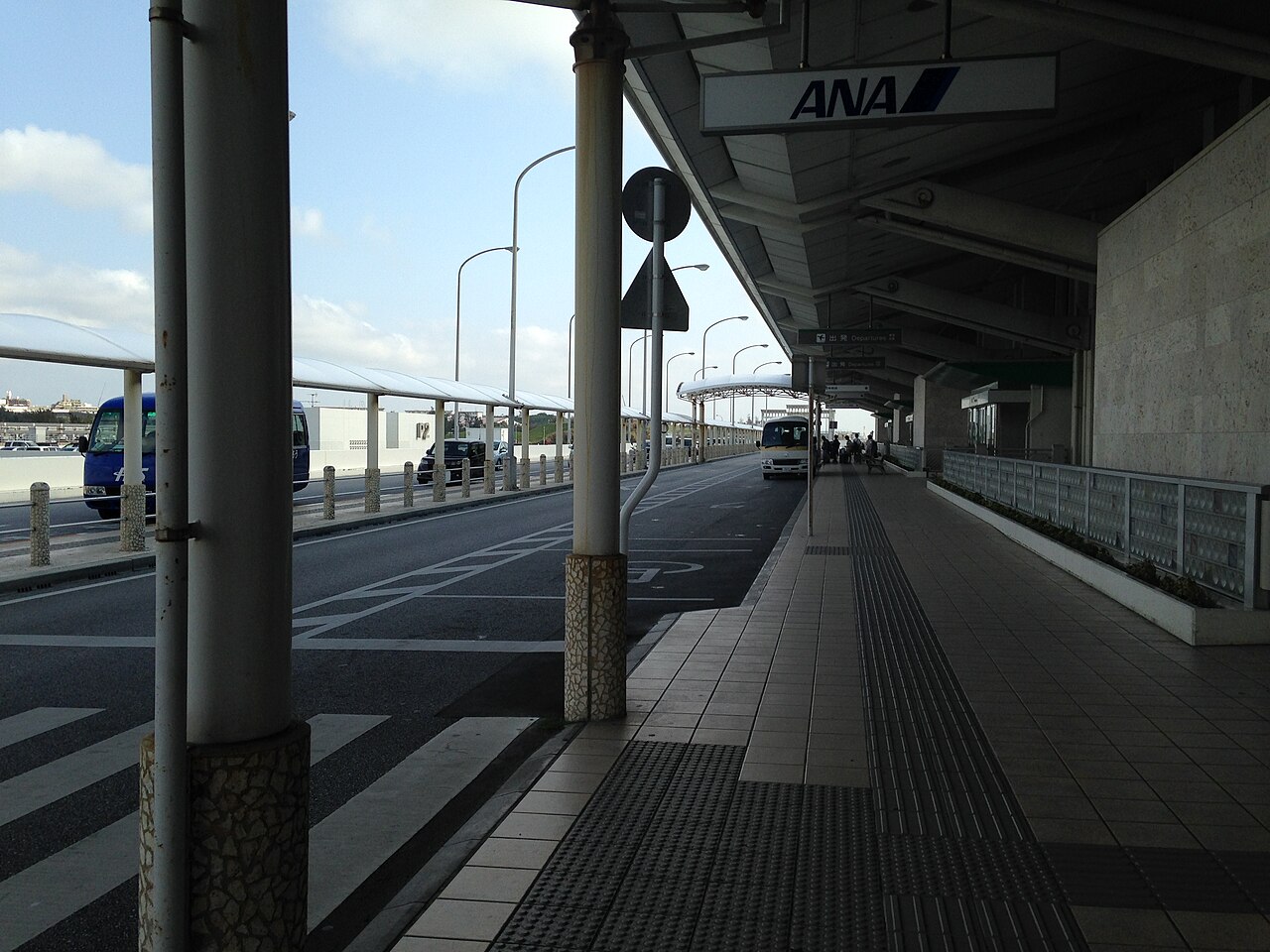
The worst thing about traffic jams is not being able to make it to your car return or your flight on time. On the last day of your trip, don’t pack in too many sights, and plan with a margin, working backward from your return time and your flight time. Thinking in the following order makes it easier to build the schedule.
- First, check your flight’s departure time and the check-in deadline given by your airline
- Subtract the time needed after returning the car (the procedure at the store and the trip to the airport)
- Add a traffic margin to the travel time to the return store
- Fill up the tank early, near the return store
At UMUI Rent a Car, cars are returned only at our stores. After returning a car at the Naha Airport store, a free shuttle takes you to the airport. The Naha Airport store is open every day of the year from 8:00 to 20:00, and the Omoromachi store is open from 9:00 to 18:00. Your return time depends on the details of your reservation, so please check the information sent after you book.
Frequently Asked Questions
What time should I leave in the morning to avoid traffic?
The congested times change depending on the day of the week, the season and your destination, so we have not been able to confirm a figure that lets us say “this time is fine.” For the northbound routes during holidays, news reports say traffic tends to build from the 9 a.m. hours until around noon, so shifting your timing, such as leaving early in the morning or waiting until after midday, makes things easier.
To avoid traffic, can I follow the navigation onto narrow roads?
We don’t recommend it. Residential roads have many pedestrians and cyclists, and they are dangerous on unfamiliar ground. This article introduces only the use of expressways and routes advised by public bodies.
What should I do if I end up in the bus lane?
During the regulated hours, ordinary vehicles may not drive in the bus lane. If you notice, check behind you for safety and then move into a lane you may use, at a point where you can do so without forcing it. For details on how it is handled, you can ask the Traffic Regulation Division of the Okinawa Prefectural Police (098-862-0110, ext. 5172).
Okinawa’s traffic becomes far easier to live with simply by shifting your timing, checking information and leaving a margin. If you are unsure how to plan your trip by rental car, feel free to consult UMUI Rent a Car. Our Naha Airport store has a free shuttle from the airport, and our booking site is available in Japanese, English, Korean and Traditional Chinese.
* Information in this article is as of October 2026. Bus lane regulation hours, road conditions and published data may change. Please check the latest information on the official websites of the Okinawa Prefectural Police, Okinawa Prefecture, the Okinawa General Bureau, NEXCO West Japan and JARTIC. Main sources: Okinawa Prefecture Transport Policy Division, “Current State and Issues of Public Transport in Okinawa Prefecture, and Measures for Traffic Congestion and Introduction of Rail” (January 30, 2026); Okinawa Prefecture Civil Engineering and Construction Department’s congestion countermeasure page; Okinawa Prefectural Police Headquarters, “About bus lane regulations” and its map (valid from May 2, 2025); the Tokyo Metropolitan Police’s traffic fine list; the Japan Road Traffic Information Center’s service guide; and Ryukyu Shimpo’s reports on the content of “Ashinavi,” the road information magazine of the Northern National Highway Office, Okinawa General Bureau.
Photo credits: Wikimedia Commons (CC BY 4.0 / CC BY-SA 4.0). Photographers are credited in each caption. Featured image: Zairon / CC BY 4.0