“If I have an accident in a rental car, what do I do first?” “If I get a flat tire on a mountain road, who do I call?” When you drive on a trip, the biggest worry is often not that nothing will happen, but what to do if something does. On unfamiliar roads, in an unfamiliar car, and possibly without a shared language, it is natural for your mind to go blank.
This article walks through what to do, in order, if you have an accident, a breakdown, a flat tire, a dead battery or a locked-out key while driving a rental car in Okinawa. It also covers what to do if you stop on an expressway, and simple phrases you can use on an emergency call if you do not speak Japanese. UMUI Rent a Car’s contact details and coverage rules are based only on what is written on the “Coverage” page and the “Rental Agreement” page of the official website. Please read it once before you set out, so the flow is already in your head if you ever need it.
If You Have an Accident: What to Do First
Stop, Make Sure You Are Safe, and Help Anyone Who Is Hurt
If you are in an accident, stop driving immediately and put helping injured people and preventing a second accident first. Japan’s Road Traffic Act requires a driver involved in an accident to stop, help the injured, prevent further danger on the road and report to the police. UMUI’s Rental Agreement (Article 30) also says that when an accident happens you must stop driving at once and take the measures required by law, whatever the size of the accident.
The following order helps you stay calm.
- Turn off the engine and switch on the hazard lights
- Check whether anyone, including your passengers, is hurt
- If the car is in the middle of the road and can be moved, move it somewhere safe where it will not block following traffic (do not force it if moving it would be dangerous)
- Wait somewhere away from the traffic, such as the sidewalk or behind the guardrail
Moving an injured person can make their condition worse. If someone is unconscious or in severe pain, do not move them unnecessarily while you wait for the ambulance, and keep talking to them.
Call 110 and 119
In Japan, the emergency number for the police is 110, and for ambulance and fire it is 119. Both are available 24 hours a day and are free to call. If someone is hurt, call 119 for an ambulance, and call 110 to report the accident to the police. The National Police Agency’s leaflet likewise directs people to 110 for accidents and trouble, and to 119 when someone is injured.
UMUI’s coverage page states that after any accident, you must contact the police and the company immediately, regardless of the size of the accident or whether another party is involved, and that this is a requirement under Article 72 of the Road Traffic Act. This applies even to a single-vehicle accident, such as hitting a utility pole or a guardrail when nobody else was involved. Do not think “it is small, I can mention it when I return the car.” Always call the police on the spot.
Contact UMUI Rent a Car
While you contact the police, also contact UMUI Rent a Car. The Rental Agreement requires you to report to the company immediately after an accident and follow its instructions, to have repairs done at the company’s designated workshop, and to cooperate with the investigation by the company and the insurer.
| UMUI phone | 050-1783-5687 (reception 8:00-20:00, open every day of the year) |
|---|---|
| info@u-mui.com | |
| Contact outside business hours | Not stated on the official website. Please check at the time of booking or pick-up how to reach UMUI outside reception hours |
| Police / ambulance | Police 110 / Ambulance and fire 119 |
Save the phone number in your smartphone and take a photo of your rental contract, so you do not have to search for them while you are flustered. When you call, it helps to give the car model and license plate, your location, whether anyone is injured, and whether you have already contacted the police.
What Not to Do at the Scene
When you are shaken at the scene of an accident, it is easy to do something you will regret later. Please avoid the following.
- Leaving the scene without contacting the police
- Agreeing to settle on the spot when the other party says “let’s settle this” or “we don’t need the police”
- Negotiating a settlement before getting UMUI’s consent for any settlement with the other party (Rental Agreement, Article 30)
- Arranging a repair shop yourself before contacting UMUI (repairs must be done at the company’s designated workshop)
The coverage page states that insurance and coverage do not apply if you negotiate a settlement without the company’s consent or fail to cooperate in resolving the accident. Whatever the other party says, telling them “I will speak after I contact the rental company and the police” also protects you.
If You Do Not Speak Japanese: Emergency Phrases and How to Give Your Location
Should You Call 110 or 119?
If in doubt, remember: 119 if someone is injured or ill, and 110 for accidents, theft and similar. On 119, you are generally asked first whether it is a fire or an emergency (“kaji desu ka, kyūkyū desu ka?”). If there is an injured person in an accident, answer “emergency” (kyūkyū).
According to news reports, both 110 and 119 have systems for calls in languages other than Japanese. The police are expanding the use of staff who speak foreign languages and transfers to interpreter centers, and fire departments have introduced three-way calls through telephone interpreting centers. The languages available differ by local fire department, so you cannot count on being able to speak your own language every time, but English, Chinese and Korean are reported to be supported in many areas. Even if your Japanese is limited, please do not hesitate to call.
Phrases You Can Use As They Are
Once the call connects, saying what you need in English, such as “Police, please.” or “Ambulance, please.”, often gets through. Saying it in Japanese makes things smoother. Romanized readings are included so you can say them aloud.
| 事故です Jiko desu |
“It’s an accident.” |
|---|---|
| けが人がいます Keganin ga imasu |
“Someone is injured.” |
| 救急車をお願いします Kyūkyūsha o onegai shimasu |
“An ambulance, please.” |
| 警察をお願いします Keisatsu o onegai shimasu |
“The police, please.” |
| 車が故障しました Kuruma ga koshō shimashita |
“My car has broken down.” |
| 高速道路です Kōsoku dōro desu |
“I’m on the expressway.” |
Tips for Giving Your Location
The most important thing in an emergency call is where you are. Check your current address or place name on a map app on your smartphone, or tell them the name of a nearby shop, intersection or bus stop, or the text on a sign. Even if you do not know the address, reading out the name of a landmark lets the person taking your call work out where you are. On an expressway, it helps to give your direction of travel (toward Naha or toward Nago, for example) and the number on the distance marker beside the road. It is also an option to stay on the line and use a translation app to help the conversation.
Where to Turn for Help After Calling
If it is not serious enough for an ambulance but you have trouble on your trip, you can use the Japan National Tourism Organization (JNTO)’s multilingual call center, the “Japan Visitor Hotline” (050-3816-2787). According to JNTO, it operates 24 hours a day, every day of the year, in English, Chinese and Korean. However, it is not a line for calling an ambulance or the police. If life is at risk, call 119 or 110 without hesitating. Details are on the JNTO page.
After an Accident: Records, Police Report and Coverage
What to Record at the Scene
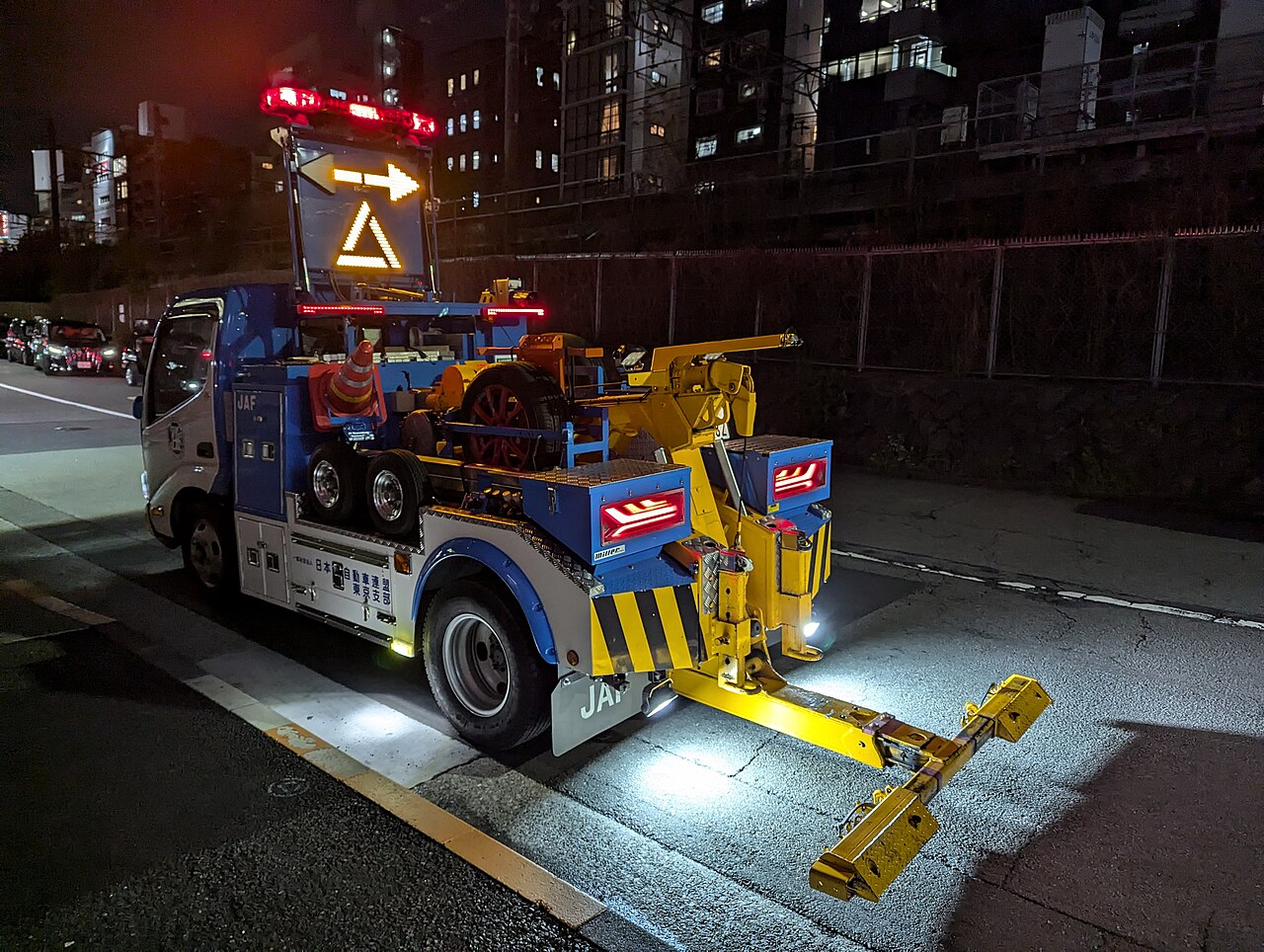
While you wait for the police, recording what you can makes the later procedures smoother. Your own safety comes first, though. Where traffic is moving, do not go out into the road to take photos.
- A photo showing where the accident happened (the road and nearby landmarks)
- Photos of the damage to your car and the other car, and of the license plates
- The other party’s name, contact details and license plate number (and, if possible, their insurance company)
- Contact details of any witnesses
The Rental Agreement also states that rental cars may be equipped with a drive recorder or an on-board accident recording device, and the conditions at the time of an accident may be recorded.
Getting a Police Accident Report
UMUI’s coverage page asks you to obtain an accident report from the police if an accident occurs. In addition, the Rental Agreement (Article 34) states that insurance and the coverage system do not apply to an accident that has not been reported to the police and the company. In other words, contacting the police leads to the accident report, and is also a precondition for receiving coverage. For how to obtain the report and the details of the procedure, follow UMUI’s instructions.
How Coverage and NOC Work
UMUI Rent a Car’s base rate already includes the cost of car insurance, deductible coverage and NOC coverage (except for bookings made through some external booking sites). However, coverage has monetary limits, and damage from accidents that fall under certain conditions or exclusions, or from improper procedures, is the customer’s responsibility.
NOC (Non-Operation Charge) is compensation for the period when the car cannot operate because it needs repair or cleaning after an accident, breakdown, theft or soiling. The coverage page states that the customer pays 20,000 yen if the car is returned to the branch under its own power, and 50,000 yen (plus towing cost) if it cannot be driven. The NOC coverage system covers this customer-borne amount (up to 50,000 yen) and the towing cost. For what the coverage includes, the deductibles, and examples of what is excluded, see our blog article “Okinawa Rental Car Coverage Explained: Deductible and NOC (Non-Operation Charge)”.
If the Car Can No Longer Be Used
The Rental Agreement (Article 32) states that if the car becomes unusable because of a breakdown, accident, theft or similar, the rental contract ends. If the cause was a defect that existed before the rental, a replacement car is provided, and if it was for a reason that is not the responsibility of either party, the rental fee for the unused period is refunded. What happens next, such as how you get around and how the car is returned, depends on the situation. Follow UMUI’s instructions. If additional charges arise from the accident, such as the deductible amount or compensation for the car being out of service, they are settled when the car is returned.
Breakdown, Flat Tire, Dead Battery and Locked-In Keys
The Basics: Stop, Get to a Safe Place, Contact UMUI
The Rental Agreement (Article 29) says that if you notice an abnormality or breakdown in the car while using it, you must stop driving at once, contact the company and follow its instructions. If a warning light comes on, you hear strange noises or feel vibration, or you smell something burning, stop in a safe place as soon as you notice an abnormality and contact UMUI. If you keep driving because your destination is “just a little further,” the car may be damaged, or you may end up stopped in a dangerous place.
Before you call a repair shop or roadside assistance yourself, always contact UMUI and get instructions. While you wait, stay somewhere safe, such as behind the guardrail or on the sidewalk, rather than inside the car.
If You Get a Flat Tire
If the steering pulls, the car shakes, or the tire pressure warning light comes on, you may have a puncture. Slow down gradually and stop in a safe place. Driving on can damage not only the tire but also the wheel.
Please note that UMUI’s coverage page states that tire punctures and damage, and lost wheel caps, are not covered. Everyday habits, such as not scraping tires against curbs and not riding up on steps when parking, are the best prevention. How to respond to a flat, such as whether you may use the spare tire or a repair kit, may differ by car, so call UMUI to confirm before you start any work yourself.
If the Battery Is Dead
If the engine will not start or reacts weakly when you press the start button, the battery may be dead. Common causes include leaving the headlights or interior lights on, or using the navigation or music for a long time with the engine off. Checking that you have not left any lights on when you get out helps prevent it.
The method of connecting cables to another car to start the engine may differ for hybrid and electric vehicles. Before you try it yourself, contact UMUI and get instructions. The coverage page has no specific statement about dead batteries. Checking with UMUI, including how costs are handled, is the surest approach.
If You Lock the Key in the Car or Lose It
This is the trouble of closing the door and finding the key left inside, or that you do not have the smart key with you. If you pry open the door or call a locksmith yourself, you may damage the car. First, call UMUI and get instructions.
In addition, UMUI’s coverage page states that lost keys, and theft after parking with the key left in the car, are not covered by insurance and the coverage system. If you lose a key, the customer pays the actual cost of the key itself and its return, which UMUI pays out of pocket. When you park, make sure you have the key before closing the door, and never leave the key inside the car.
If You Stop on an Expressway
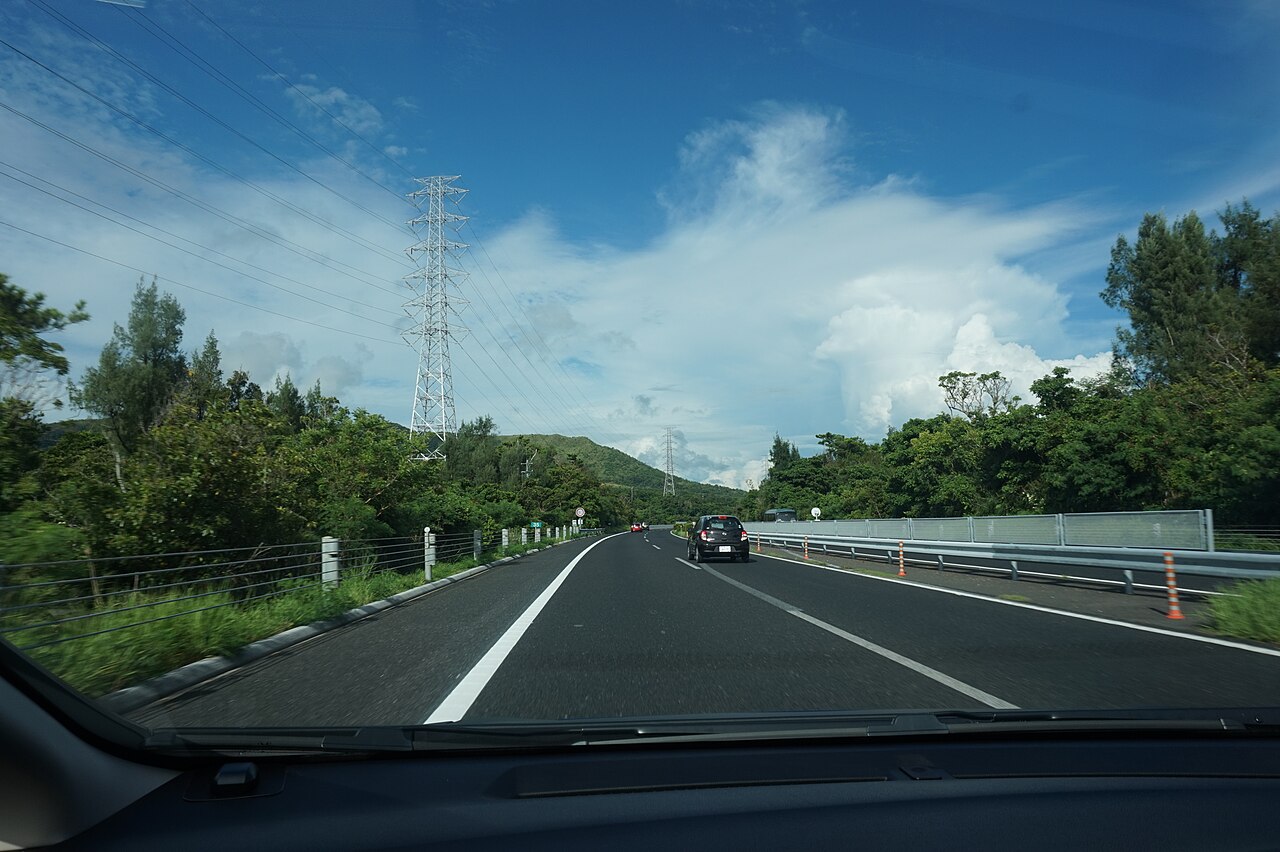
Turn On the Hazard Lights and Move as Far Left as Possible
The Okinawa Expressway is managed by NEXCO West Japan. If your car breaks down or you have an accident on an expressway, the danger is greater than on ordinary roads because other cars are traveling at high speed. First, turn on the hazard lights and stop as far to the left on the shoulder as you can. Even if the car can still move, do not keep driving; find a place where you can stop safely and stop early.
Stop Sign (Warning Triangle) and Flare
When you stop on an expressway or motor-vehicle-only road because of a breakdown or similar, the Road Traffic Act requires you to place a stop indicator (the so-called warning triangle) or similar behind the vehicle to alert following traffic. NEXCO describes three steps: turn on the hazard lights, light a flare, and set up a stop indicator. About 50 m or more behind the car is given as a guide, but do it only as far as is reasonable, and put safety first. It is dangerous to step out onto the road to set one up while cars are coming from behind.
Whether the car you rent carries a stop indicator or flare cannot be confirmed from UMUI Rent a Car’s official website. It is reassuring to ask the staff at pick-up.
Everyone Moves Outside the Guardrail
The inside of a stopped car is not safe, because a car coming from behind may hit it. NEXCO also advises that the driver and all passengers move to a safe place such as the outside of the guardrail. On an expressway, do not stay in the car; everyone should move to a safe place such as outside the guardrail. When you move, do not wander along the main lanes or the shoulder, and watch your step. Hold small children by the hand and take them to safety first.
Report from a Safe Place
Once you have moved to safety, report the situation. You can use 110, an emergency telephone on the road, or the Road Emergency Dial #9910. #9910 is a service for reporting road problems to the road operator from a mobile phone, and NEXCO says it is free to call 24 hours a day. Follow the voice guidance to choose the road operator. If someone is injured in an accident, also call 119. Emergency telephones on expressways are being scaled back in some places, so reporting by mobile phone is the basic method.
After you report, also call UMUI Rent a Car, explain the situation and get instructions. If the car has to be towed, check with UMUI about the cost together with the NOC coverage. For how to drive the Okinawa Expressway, see our Okinawa Expressway guide, and for the procedure after an accident or breakdown, see NEXCO West Japan’s guidance (Japanese).
Preparing Before You Set Out
Keep Contact Details and Your Contract at Hand
Before you set out, get the following ready.
- Save UMUI Rent a Car’s phone number (050-1783-5687) in your smartphone
- At pick-up, check how to contact UMUI outside business hours and make a note of it
- Take a photo of your rental contract or booking screen
- Check the numbers for 110 (police) and 119 (ambulance), and review the basic rules in our blog article “Driving in Japan for the First Time: Okinawa Road Rules”
What to Ask at Pick-Up
Some information is not written on UMUI Rent a Car’s official website. If you check the following at booking or pick-up, you will not be left unsure when something happens.
| Contact outside business hours | Not stated on the official website. Check at booking or pick-up |
|---|---|
| Stop indicator and flare | Check at pick-up whether the car carries them |
| If you get a flat tire | Check at pick-up whether there is a spare tire or repair kit, and whether you may use it |
| Handling of keys | Check at pick-up how to use the smart key and what to do if you lose it |
Leave Yourself Room Until You Are Used to It
Many accidents and breakdowns come from fatigue, haste and an unfamiliar driving environment. A relaxed plan, such as keeping the first day’s distance short, avoiding mountain roads in the evening and at night, and taking frequent breaks, is the best way to prevent trouble. You can check how coverage works and which acts are excluded on the coverage page and in the Rental Agreement.
Frequently Asked Questions
I only hit a utility pole or curb, and nobody is hurt and no one else was involved. Do I still need to report it?
Yes. UMUI’s coverage page states that after any accident, regardless of its size or whether another party is involved, you must contact the police and UMUI immediately, as a requirement under Article 72 of the Road Traffic Act. Without that contact, insurance and the coverage system may not apply.
Can I call JAF roadside assistance myself?
Please contact UMUI first and get instructions. The Rental Agreement says that when you find a breakdown, you must contact the company and follow its instructions. For reference, according to JAF’s official website, JAF roadside assistance can be used by non-members, but it is a paid service, and members may be given priority when it is busy (see the JAF FAQ (Japanese)). If you arrange help without UMUI’s instructions, it may become unclear how the cost is handled.
What if trouble happens at night or early in the morning, outside business hours?
In an emergency, such as when someone is injured or the car is in a dangerous spot on the road, first call 119 or 110 and make sure you are safe. How to contact UMUI Rent a Car outside reception hours is not written on the official website. Be sure to check how to reach UMUI outside business hours at booking or pick-up.
The best accident or breakdown is the one that never happens. Even so, if you know the flow in advance, you can act calmly when it counts. UMUI Rent a Car offers a free shuttle from Naha Airport, and its booking site is available in Japanese, English, Korean and Traditional Chinese. If anything worries you, please feel free to contact us even before you book. Drive safely, and enjoy your trip to Okinawa.
* The information in this article is current as of October 2026. Laws and company guidance may change, so please check the latest information on the UMUI Rent a Car official website and with the National Police Agency, NEXCO, JAF and JNTO.
Photo credits: Wikimedia Commons (CC0 / CC BY 4.0 / CC BY-SA 4.0). Photographers are credited in each photo’s caption.